



By now we all know that customers move through several stages before they buy. We usually describe those stages as a sales funnel. But if buying happens in stages, the relationship with the customer has to follow the same path to deliver a good experience.
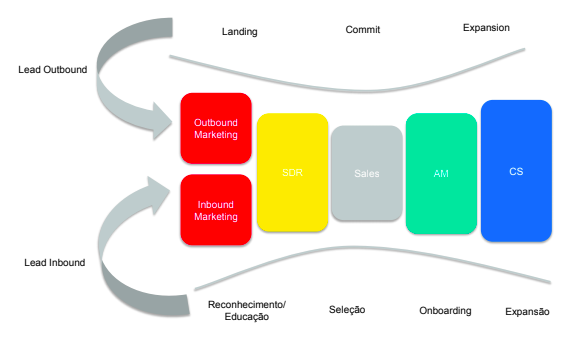
That is why an inbound marketing and inside sales operation ideally has three distinct roles: a marketing specialist generating leads at the top of the funnel, a Sales Development Representative qualifying them during the engagement phase, and an Account Executive closing the deal.
As a company grows, or tries to take bigger steps, expanding that structure and hiring for every role becomes essential — both for the customer experience and for staying competitive.
So let’s look in detail at what each role is expected to do, and what to look for in candidates joining your inbound marketing and inside sales team.
Attraction
At the top of the funnel, marketing runs paid and owned media initiatives to earn the target audience’s attention. Content built specifically to attract the right person drives visits across the channels the company manages, and those visits are the first phase of lead generation.
Generating those leads is the responsibility of the inbound and outbound marketing specialists. A strong marketer builds personas from what sales reports back and from the quantitative data in analytics tools. Knowing the persona well means knowing their preferred channels and their pain points — and that is where every ingredient of a successful inbound and outbound plan comes together.
What to look for in an inbound and outbound marketing specialist:
- Ability to analyse data and draw insights from it
- Organisation and project management skills
- Understanding and appreciation of automation
- Deep grasp of the customer experience
- Working knowledge of UX
- Advanced knowledge of social platforms
- Strategic thinking
Awareness and education
The purpose of this phase is to convert those visits into leads. Marketing is still working here, creating the content and the mechanisms that capture a visitor’s contact details and turn them into a lead.
This is where the Sales Development Representative (SDR) comes in. It is usually a junior position, and its core function is contacting leads — most often by phone — to qualify them.
To do that, SDRs apply qualification criteria drawn from the Ideal Customer Profile and pass the best opportunities to sales. They are the first human contact between the company and a potential customer, so they need to know the product range inside out.
What to look for in a Sales Development Representative:
- A natural communicator — which means active listening as much as speaking
- Coachability, or openness to being mentored
- Curiosity, appetite for learning and quick absorption of new knowledge
- Organisation and excellent time management
- Empathy and the ability to build relationships
- Ability to adapt to whoever is on the other end of the call
Selection
In the selection phase, the lead becomes a sales opportunity. They have consumed the content, they feel able to decide and they are ready to negotiate — though they are almost certainly comparing you with competitors.
This is the moment for the Account Executive. They negotiate, present the proposal and close the deal. Educating is no longer the objective; helping the prospect make the best decision for themselves is. Results matter to them, but they are specialists in building relationships, not just in closing.
What to look for in an Account Executive:
- Strong written and verbal communication
- An assertive, confident manner
- Organisation, planning and time management
- Results orientation
- High self-motivation
- Enthusiasm, perseverance and resilience
- Working knowledge of CRM tools
- Command of sales techniques
- Emotional intelligence
- Previous sales experience
Onboarding
The period right after the purchase carries a lot of expectation. The customer wants quick confirmation that they chose well and wants to see a return on the investment. The company wants to ease implementation and adoption and deliver on the value it promised.
Customer Success Managers (CSMs) run that process, and their role doesn’t end at onboarding — they also own technical support. The ultimate goal of the role is to reduce churn and extend customer lifetime value.
What to look for in a Customer Success Manager:
- Creativity and problem-solving ability
- Relationship management and proactivity
- Deep technical knowledge of the product or service, which may call for other technical skills
- Empathy and active listening
- Expectation management
- Crisis management
- Excellent communication
- Comfort working as part of a team
- Strong interpersonal skills
- Ability to work well under stress and deadline pressure
Expansion
These days a sales funnel isn’t complete without an expansion phase. This is where the company can earn considerably more from an existing customer. Once customer success has secured satisfaction, it becomes far easier to open new opportunities — upselling to a higher-value solution or cross-selling another product.
Account Managers (AMs) own the commercial relationship, outside the technical scope that belongs to the CSM. Their job is to maximise customer lifetime value, which includes earning referrals to other potential customers and keeping the relationship going. They are often called “farmers”, because they cultivate the ground they already have.
What to look for in an Account Manager:
- Empathy, understanding and active listening
- Strong project management skills
- Excellent written and spoken communication
- Ability to work well in a team and independently
- Leadership and ownership
- Analytical thinking
- Strong interpersonal skills
- Expectation management
- Ability to work well under stress
Hiring for a sales team is not easy. But when you organise the roles around the customer journey, it becomes far simpler to build a team that is worth more than the sum of its parts.
Grow with Digital Selling
Digital Selling works with Growth Intelligence: strategy, managed execution, training and technology in a single partner, with AI built into the operation. We act as an extension of your team — with shared accountability for targets, an explicit SLA and a real-time dashboard — and with local teams in every market where we operate.
Predictable growth isn’t bought, it’s built. Talk to our team and see how managed execution fits your numbers.
Intelligence to grow without borders.